
Hey there! As a supplier of 180mm Sandwich Panel Walls, I often get asked about the water - vapor permeability of these panels. So, I thought I'd write a blog post to break it down for you all.
Let's first understand what water - vapor permeability is. It's basically the ability of a material to allow water vapor to pass through it. In the case of our 180mm Sandwich Panel Walls, this property is super important for a few reasons.


Why Water - Vapor Permeability Matters
When it comes to building walls, we don't want moisture to get trapped inside. If water vapor can't escape, it can lead to all sorts of problems. For example, it can cause mold and mildew growth, which is not only bad for the structure of the building but also for the health of the people inside. It can also reduce the insulation performance of the panels over time.
Our 180mm Sandwich Panel Walls are designed with a proper balance of water - vapor permeability. We don't want them to be completely impermeable because that would trap moisture. At the same time, we don't want them to be too permeable, as that could let in too much moisture from the outside.
The Structure of 180mm Sandwich Panel Walls
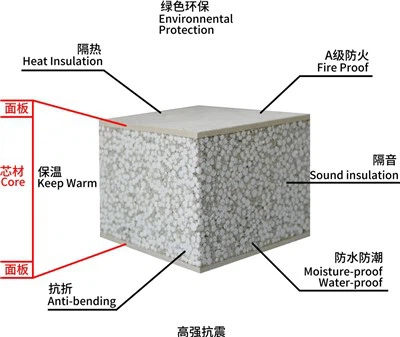
To understand the water - vapor permeability, we need to look at the structure of these panels. A typical 180mm Sandwich Panel Wall consists of two outer layers and a core layer. The outer layers are usually made of materials like steel or cement, which have different levels of water - vapor permeability. The core layer can be made of various materials such as expanded polystyrene (EPS), polyurethane foam, etc.
The EPS core, for instance, has its own unique water - vapor permeability characteristics. EPS is known for being a good insulator, but it also allows a certain amount of water vapor to pass through. This is great because it helps in keeping the moisture levels in check. You can check out more about EPS Cement Sandwich Panel on our website.
Measuring Water - Vapor Permeability
So, how do we measure the water - vapor permeability of our 180mm Sandwich Panel Walls? Well, there are standard tests like the ASTM E96 test. This test measures the rate of water - vapor transmission through a material under specific conditions.
The results of these tests are usually expressed in units like perms. The lower the perm rating, the less permeable the material is to water vapor. Our panels have been tested to meet certain industry standards. The specific perm rating can vary depending on the materials used in the panel. For example, if you choose a panel with a Soundproof EPS Panels for Walls, the water - vapor permeability might be slightly different compared to a panel with a different core material or outer layer.
Factors Affecting Water - Vapor Permeability
There are several factors that can affect the water - vapor permeability of our 180mm Sandwich Panel Walls. One of the main factors is the temperature. As the temperature changes, the movement of water vapor molecules changes, which can impact the permeability. Generally, higher temperatures can increase the rate of water - vapor transmission.
Humidity is another important factor. If the relative humidity is high, there is more water vapor in the air, and the panels will have to deal with more moisture. This can potentially increase the amount of water vapor passing through the panels.
The thickness of the panel also plays a role. A thicker panel might have a lower water - vapor permeability compared to a thinner one. This is because the water vapor has to travel a longer distance through the material.
Benefits of Our 180mm Sandwich Panel Walls' Water - Vapor Permeability
The balanced water - vapor permeability of our panels offers several benefits. Firstly, it helps in preventing condensation inside the walls. Condensation can lead to water damage and weaken the structure of the building. By allowing water vapor to pass through, we reduce the chances of condensation forming.
Secondly, it helps in maintaining a healthy indoor environment. Since there is less chance of mold and mildew growth, the air quality inside the building is better. This is especially important in places like hospitals, schools, and residential buildings.
Our Fireproof Foam Sandwich Partition Board also benefits from the proper water - vapor permeability. It ensures that the fireproof properties of the panel are not compromised by moisture.
How We Ensure Quality Water - Vapor Permeability
At our company, we take several steps to ensure that our 180mm Sandwich Panel Walls have the right water - vapor permeability. We carefully select the materials for each layer. We work with high - quality suppliers to get materials that meet our standards.
We also conduct rigorous testing during the manufacturing process. Every batch of panels is tested to make sure that they meet the required water - vapor permeability levels. If a batch doesn't meet the standards, it doesn't leave our factory.
Conclusion and Call to Action
In conclusion, the water - vapor permeability of our 180mm Sandwich Panel Walls is a crucial aspect that we take very seriously. It helps in maintaining the integrity of the building, preventing moisture - related problems, and ensuring a healthy indoor environment.
If you're in the market for high - quality 180mm Sandwich Panel Walls, we'd love to talk to you. Whether you're building a commercial space, a residential property, or an industrial facility, our panels can be a great choice. Contact us to discuss your specific needs and get a quote. We're here to help you make the right decision for your project.
References
- ASTM International. "ASTM E96 - Standard Test Methods for Water Vapor Transmission of Materials."