
As a supplier of 100mm lightweight sandwich panels, I am often asked about the sound insulation effect of these panels. In this blog post, I will delve into the factors that influence the sound insulation performance of 100mm lightweight sandwich panels, provide some scientific data, and share real - world applications.
Understanding Sound Insulation
Sound insulation is the process of reducing the transmission of sound from one area to another. It is measured in decibels (dB). The higher the sound insulation rating, the better the panel is at blocking sound. When it comes to 100mm lightweight sandwich panels, several factors contribute to their sound - insulating capabilities.
Factors Affecting Sound Insulation of 100mm Lightweight Sandwich Panels
Core Material
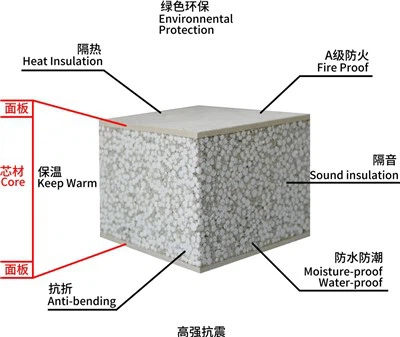
The core material of a sandwich panel plays a crucial role in sound insulation. Many 100mm lightweight sandwich panels use materials like expanded polystyrene (EPS), polyurethane foam, or mineral wool. EPS is a common choice due to its low cost and good insulation properties. It has a cellular structure that can absorb and dissipate sound energy. Polyurethane foam, on the other hand, has a higher density and can provide better sound insulation, especially for high - frequency sounds. Mineral wool is excellent at absorbing sound across a wide range of frequencies because of its fibrous structure.
Panel Structure
The structure of the sandwich panel also affects sound insulation. A well - designed panel with a proper combination of the face sheets and the core can create a barrier that reflects and absorbs sound waves. The face sheets can be made of materials such as metal, cement, or calcium silicate board. Metal face sheets can reflect sound, while cement and calcium silicate boards can add mass to the panel, which is beneficial for blocking low - frequency sounds.
Sealing and Installation
Even the best - designed sandwich panel will not perform well if it is not installed correctly. Proper sealing around the edges of the panels and at joints is essential to prevent sound leakage. Gaps and cracks can allow sound to pass through easily, reducing the overall sound insulation effect.
Scientific Data on Sound Insulation of 100mm Lightweight Sandwich Panels
Research has shown that 100mm lightweight sandwich panels can achieve a sound insulation rating of around 30 - 40 dB, depending on the core material and panel structure. For example, a 100mm EPS cement sandwich panel EPS Cement Sandwich Panel can typically provide a sound insulation of about 30 - 32 dB. This level of insulation is suitable for many residential and commercial applications, such as interior partitions in offices or bedrooms.
A 100mm waterproof cement sandwich board Waterproof Cement Sandwich Board with a high - density core may achieve a sound insulation rating of up to 35 - 40 dB. This makes it a great choice for areas where more significant sound isolation is required, like recording studios or meeting rooms.
Real - World Applications
The sound insulation properties of 100mm lightweight sandwich panels make them suitable for a variety of applications.
Residential Buildings
In residential buildings, these panels can be used for interior partitions, separating bedrooms from living areas or creating home offices. They can effectively reduce the noise from daily activities, such as conversations, television, or music, providing a more peaceful living environment.
Commercial Buildings
In commercial buildings, 100mm lightweight sandwich panels are commonly used in offices, hotels, and restaurants. They can be used to create private meeting rooms, hotel rooms, or partitions in open - plan offices. For example, in a hotel, the sound insulation of the panels can ensure that guests have a quiet and comfortable stay, free from the noise of other guests or the hotel's public areas.
Industrial Buildings
In industrial settings, 100mm lightweight sandwich panels can be used to create sound - proof enclosures for machinery. This helps to reduce the noise pollution in the workplace and protect the hearing of workers.
Comparison with Other Building Materials
Compared to traditional building materials such as brick and concrete, 100mm lightweight sandwich panels offer several advantages in terms of sound insulation. Brick and concrete walls are heavy and thick, which can provide good sound insulation. However, they are also more expensive and time - consuming to install. In contrast, lightweight sandwich panels are easy to install, cost - effective, and can still provide a reasonable level of sound insulation.


A lightweight foaming partition panel Lightweight Foaming Partition Panel is an example of a 100mm lightweight sandwich panel that can be a great alternative to traditional partition walls. It is easy to handle, has good sound insulation properties, and can be installed quickly, reducing construction time and costs.
Conclusion
In conclusion, the sound insulation effect of 100mm lightweight sandwich panels is influenced by factors such as the core material, panel structure, and installation. These panels can provide a sound insulation rating of 30 - 40 dB, which is suitable for many residential, commercial, and industrial applications. They offer a cost - effective and efficient solution for creating sound - proof spaces.
If you are interested in purchasing 100mm lightweight sandwich panels for your project, I encourage you to contact us for more information. We can provide you with detailed product specifications, samples, and professional advice on installation and sound insulation improvement. Our team is dedicated to helping you achieve the best results with our high - quality sandwich panels.
References
- ASTM E90 - 19 Standard Test Method for Laboratory Measurement of Airborne Sound Transmission Loss of Building Partitions and Elements.
- ISO 140 - 3:2010 Acoustics - Measurement of sound insulation in buildings and of building elements - Part 3: Laboratory measurements of airborne sound insulation of building elements.