
Hey there! As a supplier of lightweight partition wall panels, I often get asked about the load - bearing capacity of these panels. It's a super important question, especially when you're planning a construction project. So, let's dive right in and explore what the load - bearing capacity of lightweight partition wall panels is all about.


First off, what are lightweight partition wall panels? Well, they're panels that are used to create partitions within a building. They're lightweight compared to traditional building materials like bricks and concrete, which makes them easier to install and transport. There are different types of lightweight partition wall panels, such as the EPS Partition Wall Panel, Calcium Silicate Board for Prefabricated Houses, and EPS Cement Concrete Sandwich Panel. Each type has its own unique properties and load - bearing capacities.
The load - bearing capacity of a lightweight partition wall panel refers to the maximum amount of weight or force that the panel can support without failing. This includes both dead loads (the weight of the panel itself and any permanent fixtures attached to it) and live loads (temporary loads like people, furniture, or equipment).
Let's talk about the factors that affect the load - bearing capacity of these panels.
Material Composition
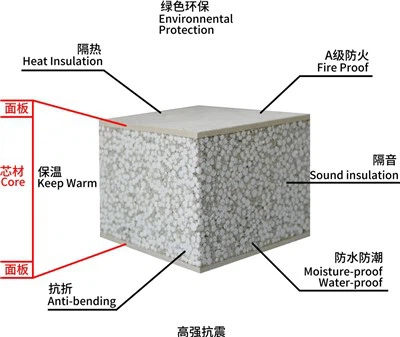
The materials used to make the panel play a huge role. For example, EPS (Expanded Polystyrene) is a common material in lightweight partition wall panels. It's very light but has relatively low load - bearing capacity on its own. However, when combined with other materials like cement or calcium silicate, the load - bearing capacity can be significantly increased. The EPS Cement Concrete Sandwich Panel is a great example. The concrete layers on either side of the EPS core provide strength and stability, allowing the panel to support more weight.
Panel Thickness
Thicker panels generally have a higher load - bearing capacity. A thicker panel can distribute the load over a larger area, reducing the stress on any one point. For instance, if you have a thin EPS partition wall panel, it might only be suitable for non - load - bearing partitions in a residential setting. But a thicker version of the same panel could potentially be used in a commercial building where there are higher loads.
Installation Method
How the panel is installed also affects its load - bearing capacity. If the panels are properly installed with a good connection to the floor, ceiling, and adjacent panels, they can better transfer the load. Improper installation, like loose connections or uneven support, can significantly reduce the load - bearing capacity. For example, if the panels are not securely fastened to the floor, they may shift under load, leading to premature failure.
Structural Design
The overall structural design of the building and how the partition wall panels fit into it is crucial. In some cases, the partition wall panels may be designed to work in conjunction with other structural elements. For example, if the building has a strong frame structure, the partition wall panels may not need to bear as much load. On the other hand, in a more open - concept building, the partition wall panels may need to be designed to support a greater share of the load.
Now, let's take a look at some typical load - bearing capacities for different types of lightweight partition wall panels.
EPS Partition Wall Panels
EPS partition wall panels are often used for non - load - bearing partitions in residential and light - commercial buildings. Their load - bearing capacity is relatively low, usually suitable for supporting only their own weight and perhaps some light fixtures. They're great for creating separate rooms quickly and easily, but don't expect them to hold up heavy equipment or large amounts of furniture.
Calcium Silicate Board for Prefabricated Houses
Calcium silicate boards have better load - bearing capacity compared to pure EPS panels. They're often used in prefabricated houses where they can support some light loads. These boards are fire - resistant and have good dimensional stability, which makes them a popular choice for interior partitions. However, their load - bearing capacity is still limited compared to more heavy - duty building materials.
EPS Cement Concrete Sandwich Panels
These panels are designed to have a higher load - bearing capacity. The combination of the EPS core and the cement concrete layers provides a good balance between light weight and strength. They can be used in both residential and commercial buildings for load - bearing partitions. In some cases, they can even be used as exterior walls, depending on the specific design and requirements.
When it comes to calculating the exact load - bearing capacity of a lightweight partition wall panel, it's a complex process. It usually involves consulting the manufacturer's specifications, as well as conducting structural calculations based on the specific application. You may also need to consider local building codes and regulations, which often have requirements for load - bearing capacities.
If you're planning a construction project and need to use lightweight partition wall panels, it's important to choose the right type based on the load - bearing requirements. Don't just go for the cheapest option; make sure the panels can handle the loads they'll be subjected to. And always work with a professional contractor or engineer who has experience with lightweight partition wall panels.
So, if you're in the market for lightweight partition wall panels and have questions about load - bearing capacity or any other aspect, feel free to reach out. We're here to help you make the right choice for your project. Whether it's the EPS Partition Wall Panel, Calcium Silicate Board for Prefabricated Houses, or EPS Cement Concrete Sandwich Panel, we've got the expertise and the products to meet your needs. Contact us today to start a discussion about your project and find the perfect lightweight partition wall panels for you.
References
- Building Construction Handbook, various editions
- Manufacturer's product specifications for lightweight partition wall panels