
Hey there! As a supplier of Waterproof Cement Sandwich Boards, I often get asked about the insulation properties of these boards. So, I thought I'd write this blog to share some insights on this topic.
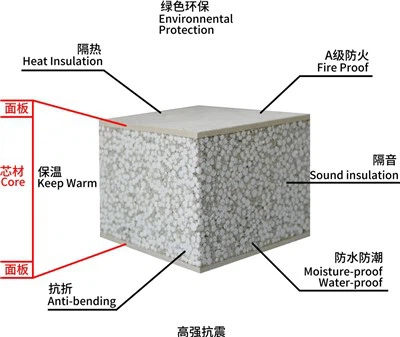
First off, let's understand what a Waterproof Cement Sandwich Board is. It's a composite panel made up of a core material sandwiched between two layers of cement-based facings. The core material can vary, but commonly it's something like expanded polystyrene (EPS), which has good insulation qualities right off the bat.
How does it insulate?
The insulation property of a Waterproof Cement Sandwich Board mainly comes from its core material. In the case of EPS core boards, EPS is a lightweight, rigid foam plastic. It's filled with millions of tiny air pockets. Air is a poor conductor of heat, which means it doesn't transfer heat easily. So, when these air - filled pockets are packed together in the EPS core, they create a barrier that slows down the transfer of heat.
Let's talk about heat transfer for a sec. There are three main ways heat can move: conduction, convection, and radiation.
Conduction: This is when heat moves through a solid material. In a Waterproof Cement Sandwich Board, the EPS core with its air pockets disrupts the path of heat conduction. The cement facings also play a role. They are relatively dense compared to the EPS core, but they are designed to work in tandem with the core. The cement layers add structural strength and also act as an additional barrier to heat conduction.
Convection: Convection is the transfer of heat through the movement of fluids (liquids or gases). The closed - cell structure of the EPS core prevents air from moving freely within it. This means there's no large - scale convection current that can carry heat through the board. So, the heat transfer due to convection is minimized.
Radiation: Heat can also be transferred in the form of electromagnetic waves. While the EPS core itself doesn't do much to block radiation directly, the cement facings can absorb and reflect some of the radiant heat. Some advanced Waterproof Cement Sandwich Boards may also have special coatings on the cement facings to enhance their ability to reflect radiant heat.
Factors affecting insulation
There are a few factors that can affect how well a Waterproof Cement Sandwich Board insulates.
Thickness: It's pretty straightforward - the thicker the board, the better the insulation. A thicker core means more air pockets and a longer path for heat to travel through, which increases the board's thermal resistance.
Density of the core material: If the EPS core has a higher density, it may have fewer air pockets, which can reduce its insulation effectiveness. On the other hand, if it's too low in density, it may not provide enough structural support. So, there's a sweet spot for density that manufacturers aim for to balance insulation and strength.
Quality of the cement facings: The quality of the cement used in the facings matters. High - quality cement can provide better protection against heat transfer and also be more durable. Some cement facings may have additives that improve their thermal properties.


Comparing with other products
We also offer other related products like the Lightweight Foaming Partition Panel, EPS Cement Concrete Sandwich Panel, and Soundproof EPS Sandwich Panel.
The Lightweight Foaming Partition Panel has similar insulation principles but is more focused on being lightweight and easy to install for partition walls. The EPS Cement Concrete Sandwich Panel combines the strength of concrete with the insulation of EPS. And the Soundproof EPS Sandwich Panel not only insulates against heat but also reduces sound transmission, which is great for buildings where noise control is important.
Benefits of using Waterproof Cement Sandwich Boards for insulation
Energy efficiency: By reducing heat transfer, these boards can help keep buildings cooler in the summer and warmer in the winter. This means less energy is needed for heating and cooling systems, which can lead to significant cost savings over time.
Moisture resistance: The "waterproof" part of the name is crucial. Moisture can degrade insulation materials over time. Since these boards are waterproof, the insulation properties remain stable even in humid or wet conditions.
Easy installation: Waterproof Cement Sandwich Boards are relatively easy to install. They come in pre - fabricated panels, which can save a lot of time and labor during construction.
Real - world applications
These boards are used in a wide range of applications. In residential buildings, they can be used for exterior walls, attic insulation, and even interior partition walls. In commercial buildings like warehouses, factories, and offices, they can help create a more energy - efficient and comfortable environment.
If you're thinking about using Waterproof Cement Sandwich Boards for your next project, or if you want to learn more about our other related products, I'd love to have a chat with you. Whether you're a contractor, builder, or just someone interested in improving the insulation of your home, we can provide the right solutions for you. Don't hesitate to reach out and start a conversation about your specific needs. We're here to help you make the best choice for your project.
References
- Building Science Corporation. "Thermal Insulation Basics."
- ASTM International. "Standards for Testing Insulation Materials."
- EPS Industry Alliance. "Properties and Applications of Expanded Polystyrene."