
Hey there! As a supplier of Fiber Cement Sandwich Panels, I often get asked about the compressive strength of these panels. So, I thought I'd take a moment to break it down for you.
First off, let's talk about what compressive strength actually means. Compressive strength is the capacity of a material to withstand axially directed pushing forces. In simpler terms, it's how much weight or pressure a panel can handle before it starts to break or deform.
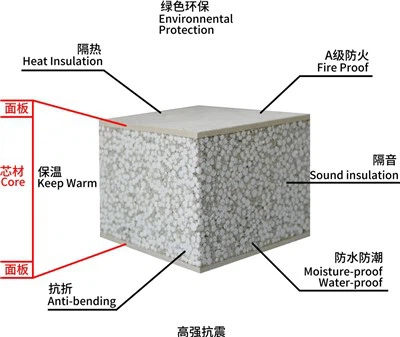
Fiber cement sandwich panels are made up of a core material sandwiched between two layers of fiber cement boards. The core material can vary, but common options include polystyrene foam, polyurethane foam, and mineral wool. Each core material has its own properties that can affect the overall compressive strength of the panel.
For instance, panels with a polystyrene foam core tend to have a lower compressive strength compared to those with a mineral wool core. Polystyrene foam is lightweight and offers good insulation properties, but it's not as strong as mineral wool. On the other hand, mineral wool is denser and more fire - resistant, which gives the panel a higher compressive strength.
The thickness of the panel also plays a crucial role in determining its compressive strength. Generally speaking, thicker panels can withstand more pressure. For example, a 180mm Sandwich Panel Wall is likely to have a higher compressive strength than a thinner panel. This is because there's more material to distribute the load, reducing the stress on any single point.
Another factor is the quality of the fiber cement boards used on the outer layers. High - quality fiber cement boards are made with a proper mix of cement, cellulose fibers, and other additives. These boards are more durable and can better transfer the compressive forces from the load to the core material.


Let's take a look at some real - world applications. In the construction of industrial buildings, where heavy equipment might be stored or where there are large roof loads, panels with high compressive strength are essential. A panel with low compressive strength might sag or crack under the weight, leading to structural problems.
For partition walls in commercial buildings, the compressive strength requirements might be a bit lower. But even here, a certain level of strength is needed to ensure that the panels can withstand normal wear and tear, like people bumping into them or furniture being moved against them.
Now, let's talk about testing. There are standard tests to measure the compressive strength of fiber cement sandwich panels. These tests usually involve applying a gradually increasing load to the panel until it fails. The maximum load the panel can bear before failure is then recorded as its compressive strength. The results are usually expressed in units of force per unit area, such as megapascals (MPa).
When it comes to our products, we've done extensive testing to ensure that our fiber cement sandwich panels meet or exceed industry standards. We offer a range of panels with different core materials and thicknesses to suit various applications. Whether you need a panel for a high - load industrial project or a more lightweight partition wall, we've got you covered.
One of our popular products is the Foam Concrete Cement Sandwich Panel. This panel combines the insulation properties of foam concrete with the strength of fiber cement boards. It has a decent compressive strength, making it suitable for a variety of construction needs.
Another option is the Fireproof Foam Sandwich Partition Board. This board not only offers good fire resistance but also has a sufficient compressive strength for use as partition walls in commercial and residential buildings.
If you're in the market for fiber cement sandwich panels, it's important to consider the compressive strength based on your specific project requirements. Don't just go for the cheapest option, as a panel with low compressive strength might end up costing you more in the long run due to repairs or replacements.
We're here to help you make the right choice. Our team of experts can answer all your questions about compressive strength and other properties of our panels. We can also provide you with samples so you can see and test the panels for yourself.
If you're interested in learning more about our fiber cement sandwich panels or want to discuss your project requirements, don't hesitate to reach out. We're always happy to have a chat and help you find the perfect panels for your needs. Whether you're a contractor, an architect, or a building owner, we've got the products and knowledge to support your construction projects.
In conclusion, understanding the compressive strength of fiber cement sandwich panels is crucial for any construction project. It ensures the safety and durability of the structure. With our wide range of high - quality panels, you can be confident that you're getting a product that meets your needs. So, get in touch with us today and let's start building something great together!
References:
- Building Materials Handbook: Compressive Strength Testing Standards
- Industry Reports on Fiber Cement Sandwich Panel Performance