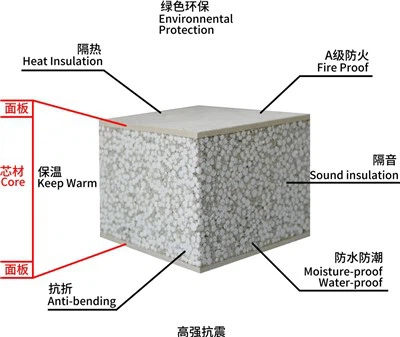

In the construction industry, 100mm lightweight sandwich panels have gained significant popularity due to their versatility, efficiency, and cost - effectiveness. As a supplier of 100mm lightweight sandwich panels, I understand the importance of certifications in ensuring the quality, safety, and performance of these products. In this blog, I will discuss the key certifications that a 100mm lightweight sandwich panel should have.
Fire Resistance Certifications
One of the most crucial aspects of any building material is its fire resistance. Fire can spread rapidly in a building, endangering lives and causing extensive property damage. Therefore, 100mm lightweight sandwich panels need to have appropriate fire - resistance certifications.
The most well - known fire - resistance certification is the Euroclass system. This classification determines the reaction to fire of construction products. For sandwich panels used in buildings, a minimum of class B, C, or D is often required depending on the building's use and location. For example, in high - rise buildings or public facilities, a higher - class rating such as B is usually mandatory.
The test for Euroclass involves exposing the panel to a controlled fire source and measuring parameters such as heat release, flaming droplets, and lateral spread of the flame. Panels that achieve a good Euroclass rating have been engineered with fire - resistant core materials and outer skins. Some panels use mineral wool as a core material, which has excellent fire - resistant properties, preventing the spread of fire and reducing heat transfer.
Thermal Insulation Certifications
Thermal insulation is another vital characteristic of 100mm lightweight sandwich panels. Good thermal insulation helps in reducing energy consumption for heating and cooling in buildings, leading to lower utility bills and a more sustainable environment.
The most common way to measure thermal insulation is through the U - value. The U - value represents the rate of heat transfer through a building element. A lower U - value indicates better thermal insulation. Certifications related to thermal insulation often involve independent testing laboratories that measure the U - value of the sandwich panel under specific conditions.
For a 100mm lightweight sandwich panel, a low U - value is desirable. Panels with high - performance insulation cores, such as expanded polystyrene (EPS), can achieve very good U - values. EPS Insulation Panels are known for their excellent thermal insulation properties. They are designed to trap air within their structure, which acts as an insulator, reducing heat transfer between the interior and exterior of a building.
Structural Integrity Certifications
The structural integrity of 100mm lightweight sandwich panels is essential, especially in load - bearing applications. These panels need to be able to withstand various loads, including dead loads (the weight of the panel itself), live loads (people, furniture, etc.), and environmental loads (wind, snow).
Certifications for structural integrity typically involve mechanical testing. Panels are tested for their compressive strength, flexural strength, and shear strength. Compressive strength is the ability of the panel to withstand a crushing force, while flexural strength measures its resistance to bending. Shear strength is important for panels that are subject to forces that cause one part of the panel to slide relative to another.
Panels that meet the relevant structural integrity certifications have been designed with appropriate core and skin materials and manufacturing processes. For example, Composite Precast Cement Wall Panel often have a strong outer layer of cement, which provides good structural support, combined with a lightweight core for reduced weight.
Sound Insulation Certifications
In modern buildings, sound insulation is becoming increasingly important. Whether it's an office building where noise can disrupt work or a residential building where peace and quiet are desired, 100mm lightweight sandwich panels should have good sound - insulating properties.
Sound insulation is measured in terms of the sound reduction index (Rw). A higher Rw value indicates better sound insulation. Sound - insulation certifications involve testing the panel in a sound - proof chamber, where the amount of sound transmitted through the panel is measured.
Some 100mm lightweight sandwich panels are specifically designed for sound insulation. Soundproof EPS Sandwich Panel use special techniques to reduce sound transmission. For example, they may have a multi - layer structure with different densities of materials that absorb and reflect sound waves, preventing them from passing through the panel.
Environmental Certifications
In today's environmentally conscious world, environmental certifications are also important for 100mm lightweight sandwich panels. These certifications ensure that the panels are produced in an environmentally friendly manner and have a low impact on the environment during their lifecycle.
One of the well - known environmental certifications is the ISO 14001. This certification indicates that the manufacturer has an environmental management system in place, which includes measures to reduce waste, conserve energy, and minimize pollution during the production process.
Another important aspect is the recyclability of the panels. Panels that are made from recyclable materials, such as some types of plastics and metals, are more environmentally friendly. Additionally, some certifications focus on the use of sustainable raw materials. For example, panels that use recycled content in their production are considered more sustainable.
Hygiene and Health Certifications
In certain applications, such as food processing facilities or hospitals, hygiene and health certifications are crucial for 100mm lightweight sandwich panels. These certifications ensure that the panels do not release harmful substances and are easy to clean and maintain.


Certifications related to hygiene often involve testing for the presence of harmful chemicals, such as volatile organic compounds (VOCs). Low - VOC panels are preferred as they do not emit harmful gases into the indoor environment, which can cause health problems for the occupants.
Panels also need to be resistant to mold and mildew growth. This is especially important in humid environments. Some panels are treated with anti - microbial agents to prevent the growth of mold and mildew, ensuring a clean and healthy indoor environment.
Conclusion
As a supplier of 100mm lightweight sandwich panels, I am committed to providing products that meet all the necessary certifications. These certifications not only ensure the quality and performance of the panels but also give our customers peace of mind. Whether it's fire resistance, thermal insulation, structural integrity, sound insulation, environmental friendliness, or hygiene, our panels are designed to meet the highest standards.
If you are in the market for 100mm lightweight sandwich panels, I encourage you to contact us for a detailed discussion about your specific requirements. We can provide you with panels that are certified and customized to your needs. Our team of experts is ready to assist you in making the right choice for your construction project.
References
- European Committee for Standardization (CEN). (2019). EN 13501 - 1:2007+A1:2009+AC:2010 Fire classification of construction products and building elements - Part 1: Classification using data from reaction to fire tests.
- International Organization for Standardization (ISO). (2015). ISO 14001:2015 Environmental management systems - Requirements with guidance for use.
- ASTM International. (2019). ASTM C168 - 15a Standard Terminology Relating to Thermal Insulation.