
As a seasoned supplier of lightweight partition wall panels, I've witnessed firsthand the transformative impact these products have on modern construction projects. Lightweight partition wall panels offer a versatile, cost - effective, and efficient solution for creating internal partitions in various buildings, from residential homes to commercial complexes. In this blog, I'll explore the different types of lightweight partition wall panels available in the market, highlighting their unique features, advantages, and applications.
1. Gypsum Board Panels
Gypsum board panels are one of the most commonly used lightweight partition wall materials. These panels are made from gypsum plaster, which is sandwiched between two layers of paper. They are known for their smooth finish, ease of installation, and fire - resistant properties.
Features
- Gypsum board panels are lightweight, making them easy to handle and transport. They typically come in standard sizes, which simplifies the installation process.
- They have good acoustic insulation properties, reducing the transmission of sound between rooms. This makes them ideal for use in offices, hotels, and residential buildings where noise reduction is important.
- Gypsum boards are also fire - resistant. They can withstand high temperatures for a certain period, providing valuable time for evacuation in case of a fire.
Advantages
- Cost - effective: Gypsum board panels are relatively inexpensive compared to other types of partition wall materials. This makes them a popular choice for budget - conscious construction projects.
- Quick installation: They can be installed quickly, which reduces the overall construction time. This is especially beneficial for projects with tight deadlines.
- Easy to decorate: Gypsum board panels have a smooth surface that can be easily painted, wallpapered, or decorated according to the design requirements.
Applications
- Gypsum board panels are commonly used in interior partition walls of residential homes, offices, schools, and hospitals. They are also suitable for creating false ceilings.
2. Fiber Cement Sandwich Panel
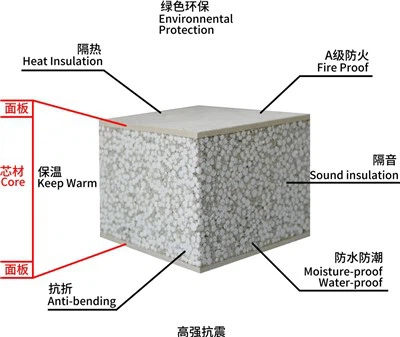
Fiber Cement Sandwich Panel is another type of lightweight partition wall panel that offers excellent performance. These panels consist of a core material, usually made of expanded polystyrene (EPS) or polyurethane foam, sandwiched between two layers of fiber cement boards.
Features
- High strength: Fiber cement boards provide a strong and durable outer layer, while the core material adds insulation and lightness. This combination results in a panel with high structural integrity.
- Weather - resistant: Fiber cement is resistant to moisture, rot, and termites. This makes the panels suitable for both interior and exterior applications, even in harsh weather conditions.
- Thermal insulation: The core material in the sandwich panel provides good thermal insulation, reducing energy consumption for heating and cooling.
Advantages
- Long - lasting: Due to their resistance to various environmental factors, fiber cement sandwich panels have a long service life. This reduces the need for frequent replacements.
- Design flexibility: These panels can be customized in terms of size, color, and texture. They can mimic the appearance of other materials such as wood or stone, providing a wide range of design options.
- Energy - efficient: The thermal insulation properties of the panels contribute to energy savings, which is beneficial for both the environment and the building's operating costs.
Applications
- Fiber cement sandwich panels are widely used in industrial buildings, warehouses, and commercial structures. They can also be used in residential buildings for exterior cladding and interior partitions.
3. EPS Cement Seismic Panel
EPS Cement Seismic Panel is a specialized type of lightweight partition wall panel designed to withstand seismic activity. These panels are made by combining EPS beads with cement and other additives.
Features
- Seismic resistance: The unique composition of EPS cement seismic panels allows them to absorb and dissipate seismic energy. This helps to protect the building and its occupants during an earthquake.
- Lightweight: EPS beads are extremely light, which makes the panels easy to install and reduces the overall weight of the building. This is particularly important for seismic - prone areas.
- Good insulation: The EPS core provides thermal and acoustic insulation, improving the comfort of the indoor environment.
Advantages
- Safety: The seismic - resistant properties of these panels enhance the safety of the building. They can prevent or minimize damage during an earthquake, reducing the risk of injury and property loss.
- Cost - effective: Despite their advanced features, EPS cement seismic panels are relatively affordable. They offer a cost - effective solution for building in seismic - prone regions.
- Easy to install: The lightweight nature of the panels makes them easy to handle and install. This can save time and labor costs during construction.
Applications
- EPS cement seismic panels are mainly used in buildings located in seismic - active areas. They are suitable for both new construction and retrofit projects.
4. EPS Cement Concrete Sandwich Panel
EPS Cement Concrete Sandwich Panel combines the advantages of EPS, cement, and concrete. These panels have an EPS core sandwiched between two layers of cement - concrete.


Features
- High load - bearing capacity: The cement - concrete outer layers provide high strength and load - bearing capacity, while the EPS core adds lightness and insulation.
- Thermal and acoustic insulation: The EPS core effectively reduces heat transfer and sound transmission, creating a comfortable indoor environment.
- Fire - resistant: The cement - concrete layers have good fire - resistant properties, enhancing the fire safety of the building.
Advantages
- Structural stability: These panels offer excellent structural stability, making them suitable for use in multi - story buildings.
- Energy - efficient: The thermal insulation properties of the panels help to reduce energy consumption, resulting in lower utility bills.
- Low maintenance: EPS cement concrete sandwich panels are durable and require minimal maintenance over their lifespan.
Applications
- EPS cement concrete sandwich panels are commonly used in high - rise buildings, industrial facilities, and large - scale commercial projects.
Contact for Procurement
If you're interested in any of these lightweight partition wall panels for your construction project, I'd be more than happy to assist you. Our company offers a wide range of high - quality products at competitive prices. We have a team of experts who can provide you with professional advice and guidance on the selection and installation of the right panels for your specific needs. Please feel free to reach out to us for more information and to start a procurement discussion.
References
- Building Construction Handbook by Roy Chudley and Roger Greeno
- Modern Building Materials and Technology by John R. Crowther
- Lightweight Construction Materials: Properties and Applications by Vipin Kumar