
As a supplier of Soundproof EPS Panels for Walls, I'm often asked about how these innovative panels work to reduce noise. In this blog post, I'll delve into the science behind soundproof EPS panels, explaining their construction, the principles of sound insulation, and the benefits they offer.
Understanding Sound and Its Transmission
Before we explore how soundproof EPS panels work, it's essential to understand the basics of sound. Sound is a form of energy that travels in waves through a medium, such as air, water, or solids. When a sound is produced, it creates vibrations in the air molecules, which then transfer these vibrations to our ears, allowing us to hear.
Sound can travel through walls in several ways. One common method is through airborne sound transmission, where sound waves in the air strike the wall and cause it to vibrate. These vibrations are then transmitted through the wall and radiated as sound on the other side. Another way is through structure - borne sound transmission, which occurs when vibrations are directly transferred through the building structure, such as when footsteps on a floor cause the ceiling below to vibrate and produce sound.
Construction of Soundproof EPS Panels
Soundproof EPS panels are typically made from expanded polystyrene (EPS), a lightweight and rigid foam material. EPS is created by expanding small beads of polystyrene using steam. This process results in a material with a large number of closed - cell air pockets, which gives EPS its excellent insulating properties.
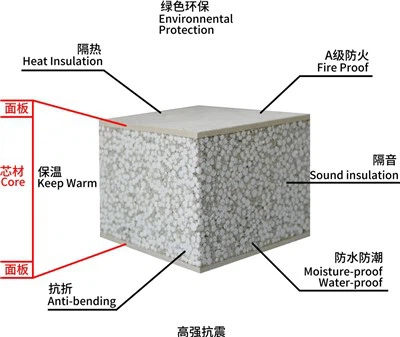
The basic structure of a soundproof EPS panel often consists of an EPS core sandwiched between two outer layers. These outer layers can be made of various materials, such as cement boards, gypsum boards, or metal sheets. The choice of outer layer depends on the specific application and the desired level of sound insulation, as well as other factors like durability and fire resistance.
For example, our 100mm Lightweight Sandwich Panel features a high - quality EPS core with well - selected outer layers. The lightweight nature of the panel makes it easy to handle and install, while the combination of the EPS core and outer layers provides effective soundproofing.
Principles of Sound Insulation in EPS Panels
The effectiveness of soundproof EPS panels in reducing noise is based on several key principles:


Absorption
One of the primary ways EPS panels reduce sound is through absorption. The numerous closed - cell air pockets in the EPS core act as tiny resonators. When sound waves enter the panel, they cause the air in these pockets to vibrate. This vibration dissipates the sound energy as heat, effectively reducing the amount of sound that passes through the panel. The porous structure of EPS allows it to absorb a wide range of sound frequencies, from low - frequency bass sounds to high - frequency treble sounds.
Mass and Density
The mass and density of a material play a crucial role in sound insulation. Generally, the heavier and denser a material is, the better it is at blocking sound. While EPS itself is lightweight, the combination of the EPS core and the outer layers in a soundproof panel increases the overall mass. This added mass helps to prevent sound waves from easily passing through the panel. For instance, a panel with a thick EPS core and dense outer layers can significantly reduce airborne sound transmission.
Damping
Damping is another important principle in sound insulation. When sound waves cause the panel to vibrate, damping materials in the panel or the structure of the panel itself help to reduce these vibrations. In soundproof EPS panels, the interaction between the EPS core and the outer layers can provide damping effects. The outer layers can be designed to absorb and dissipate the energy of the vibrations, preventing them from being transmitted through the panel.
Benefits of Using Soundproof EPS Panels for Walls
There are several advantages to using soundproof EPS panels for walls:
Cost - Effective
Compared to some other soundproofing materials, EPS panels are relatively inexpensive. The cost - effectiveness makes them an attractive option for both residential and commercial applications. Whether you're looking to soundproof a home theater, an office, or an apartment, soundproof EPS panels can provide a budget - friendly solution.
Easy Installation
EPS panels are lightweight and easy to cut and shape. This makes them simple to install, even for DIY enthusiasts. They can be attached to existing walls using adhesives or mechanical fasteners, reducing the time and labor required for installation. Our Expanded Polystyrene Wall Panels are designed for easy installation, allowing you to quickly and efficiently soundproof your space.
Thermal Insulation
In addition to sound insulation, EPS panels also offer excellent thermal insulation properties. The closed - cell structure of EPS helps to reduce heat transfer, keeping your space warmer in the winter and cooler in the summer. This dual functionality can lead to energy savings and increased comfort in your building.
Environmental Friendliness
EPS is a recyclable material, and many soundproof EPS panels are made from recycled content. Using these panels can contribute to a more sustainable building environment. Additionally, the energy savings achieved through the thermal insulation properties of EPS panels can further reduce the environmental impact of a building.
Real - World Applications
Soundproof EPS panels have a wide range of applications in different settings:
Residential Buildings
In homes, soundproof EPS panels can be used in bedrooms, home theaters, and living rooms to reduce noise from outside traffic, neighbors, or other household activities. They can also be installed in basements or attics to create a more peaceful and private space.
Commercial Buildings
In commercial settings, such as offices, restaurants, and hotels, soundproof EPS panels can improve the acoustics of the space. They can reduce noise distractions, enhance privacy, and create a more comfortable environment for employees, customers, and guests. For example, in an open - plan office, installing soundproof panels on the walls can help to reduce the spread of noise between workstations.
Industrial Buildings
Industrial facilities often generate a significant amount of noise from machinery and equipment. Soundproof EPS panels can be used to line the walls of these buildings to reduce noise pollution and protect the hearing of workers. Our 90mm Waterproof EPS Sandwich Panel is suitable for industrial applications where waterproofing is also a concern.
Conclusion
Soundproof EPS panels for walls are an effective and versatile solution for reducing noise in various settings. Their construction, based on the use of expanded polystyrene and appropriate outer layers, allows them to utilize the principles of absorption, mass, density, and damping to provide excellent sound insulation. With benefits such as cost - effectiveness, easy installation, thermal insulation, and environmental friendliness, these panels are a popular choice for both residential and commercial projects.
If you're interested in learning more about our soundproof EPS panels or would like to discuss a potential project, we encourage you to reach out to us. Our team of experts is ready to assist you in finding the right soundproofing solution for your needs. Contact us today to start the conversation about improving the acoustics of your space.
References
- Beranek, Leo L. "Acoustics." American Institute of Physics, 1954.
- Craik, R. J. M. "Handbook of Noise and Vibration Control." E & FN Spon, 1996.