
Hey there! As a supplier of EPS Partition Wall Panels, I've gotten a ton of questions about how these panels hold up when it comes to impact resistance. So, I thought I'd take a deep dive into this topic and share some insights with you all.
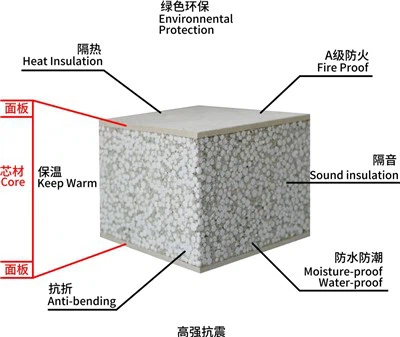
First off, let's quickly go over what EPS Partition Wall Panels are. EPS stands for Expanded Polystyrene, which is a lightweight and rigid foam material. These panels are typically made by sandwiching an EPS core between two layers of facing materials, like Calcium Silicate Cement Board. They're popular for creating interior partitions in buildings because they're easy to install, cost - effective, and have good insulation properties.
Now, let's talk about impact resistance. When we say a material has good impact resistance, we mean it can withstand sudden forces or blows without getting damaged easily. This is super important for partition walls, especially in high - traffic areas like offices, schools, or commercial buildings.
One of the main factors that contribute to the impact resistance of EPS Partition Wall Panels is the EPS core. EPS has a unique cellular structure that can absorb and distribute energy when an impact occurs. Think of it like a cushion. When you hit a wall made of EPS panels, the energy from the impact is spread out over a larger area within the EPS core, rather than being concentrated in one spot. This helps prevent cracks and breaks in the panel.
The facing materials also play a crucial role. For example, Calcium Silicate Cement Board is a common choice for the outer layers of EPS Partition Wall Panels. It's a strong and durable material that can protect the EPS core from direct impacts. The board has good flexural strength, which means it can bend a little under pressure without breaking. This flexibility allows it to absorb some of the impact energy before it reaches the EPS core.
In addition to the materials, the thickness of the panel also affects its impact resistance. Thicker panels generally have better impact resistance because they have more material to absorb and distribute the energy. For instance, our 120mm EPS Wall Panels are more resistant to impacts compared to thinner panels. The extra thickness provides an additional layer of protection and gives the EPS core more space to absorb the energy.
But how do we test the impact resistance of these panels? Well, there are several industry - standard tests that we use. One common test is the pendulum impact test. In this test, a pendulum with a specific weight and shape is swung against the panel. The height from which the pendulum is released determines the amount of energy it has when it hits the panel. We then measure the damage to the panel, such as cracks or holes, and use this data to evaluate its impact resistance.
Another test is the drop - weight test. In this test, a weighted object is dropped from a certain height onto the panel. Similar to the pendulum test, we observe the damage to the panel and use it to assess its ability to withstand impacts.
Based on these tests, our EPS Partition Wall Panels have shown excellent performance in terms of impact resistance. They can withstand moderate to high - energy impacts without significant damage. This makes them a great choice for areas where there's a risk of accidental impacts, like corridors, stairwells, or near equipment.
It's also worth mentioning that proper installation is key to ensuring the full impact - resistant potential of EPS Partition Wall Panels. If the panels are not installed correctly, they may not be able to distribute the impact energy effectively. For example, if the panels are not properly secured to the framing, they may move or shift when an impact occurs, which can lead to damage. That's why we always recommend having our panels installed by professional installers who are familiar with the proper installation techniques.
Now, let's compare EPS Partition Wall Panels with other types of partition wall materials in terms of impact resistance. Traditional brick or concrete walls are known for their high strength and durability, but they can be heavy and expensive to install. On the other hand, drywall partitions are lightweight and easy to install, but they may not be as resistant to impacts as EPS panels. EPS Partition Wall Panels offer a good balance between impact resistance, cost, and ease of installation.
In conclusion, EPS Partition Wall Panels perform very well in terms of impact resistance. Thanks to the unique properties of the EPS core, the strength of the facing materials, and the proper panel thickness, these panels can withstand a fair amount of abuse. Whether you're looking to partition an office space, a school classroom, or a commercial building, our EPS Partition Wall Panels are a reliable choice.


If you're interested in learning more about our EPS Insulation Panels or want to discuss your specific project requirements, feel free to reach out. We're here to help you find the best solution for your needs. Let's start a conversation and see how our EPS Partition Wall Panels can work for you!
References
- ASTM International. (Standards related to impact testing of building materials)
- Industry research reports on partition wall materials and their performance.