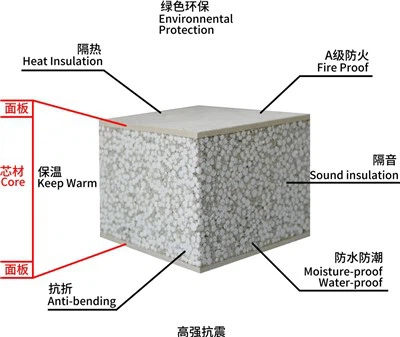

EPS sandwich panels have gained significant popularity in the construction industry due to their lightweight, insulation properties, and cost - effectiveness. As a supplier of EPS sandwich panels, one of the most frequently asked questions I encounter is whether these panels have good seismic performance. In this blog, we will delve into the scientific aspects of EPS sandwich panels' seismic performance and explore their suitability for earthquake - prone regions.
Structural Composition of EPS Sandwich Panels
EPS sandwich panels consist of an expanded polystyrene (EPS) core sandwiched between two outer layers. The outer layers can be made of various materials such as metal, cement, or fiberglass. The EPS core provides excellent insulation, while the outer layers offer strength and protection. The combination of these materials results in a panel that is both lightweight and relatively strong.
The lightweight nature of EPS sandwich panels is a crucial factor in their seismic performance. During an earthquake, the inertial forces acting on a structure are proportional to its mass. Therefore, a lighter structure experiences lower inertial forces compared to a heavier one. This means that buildings constructed with EPS sandwich panels are less likely to be severely damaged by seismic activity.
Energy Dissipation Mechanisms
One of the key aspects of seismic performance is the ability of a structure to dissipate the energy generated during an earthquake. EPS sandwich panels have inherent energy - dissipation capabilities. The EPS core acts as a shock absorber, absorbing and dissipating the energy of seismic waves. When an earthquake occurs, the EPS core deforms slightly, converting the kinetic energy of the seismic waves into heat energy through internal friction.
Moreover, the connection between the EPS core and the outer layers also plays a role in energy dissipation. The bonding between these components allows for some relative movement, which further helps in absorbing and dissipating seismic energy. This energy - dissipation mechanism reduces the stress on the overall structure and minimizes the risk of structural failure.
Flexibility and Ductility
Flexibility and ductility are important properties for structures in earthquake - prone areas. EPS sandwich panels exhibit a certain degree of flexibility, which allows them to bend and deform without breaking under seismic loads. This flexibility enables the panels to adapt to the dynamic movements caused by an earthquake, reducing the likelihood of brittle failure.
Ductility refers to the ability of a material to undergo large plastic deformations before failure. The EPS core in sandwich panels has some ductile properties, which contribute to the overall ductility of the panel. This means that even if the panel is subjected to significant seismic forces, it can deform plastically rather than failing suddenly. This characteristic is particularly beneficial in seismic events, as it provides a warning sign before complete failure and allows for potential repairs.
Case Studies and Research Findings
Numerous case studies and research projects have been conducted to evaluate the seismic performance of EPS sandwich panels. In some earthquake - affected regions, buildings constructed with EPS sandwich panels have shown remarkable resilience. For example, in a recent earthquake in a moderately seismic area, a building made of EPS sandwich panels suffered only minor damage, while adjacent buildings with traditional construction methods experienced more severe structural failures.
Research studies have also confirmed the positive seismic performance of EPS sandwich panels. Laboratory tests have demonstrated that these panels can withstand a certain level of seismic loading without significant damage. These tests have measured parameters such as displacement, stress, and strain under simulated seismic conditions, providing quantitative evidence of the panels' seismic capabilities.
Considerations for Seismic Design
While EPS sandwich panels have good seismic performance, proper seismic design is still essential. The design of a building using EPS sandwich panels should take into account factors such as the local seismic hazard level, the height and configuration of the building, and the type of foundation.
For instance, in high - seismic areas, additional reinforcement may be required to enhance the panels' seismic resistance. This could involve using stronger outer layers or improving the connection details between the panels. The foundation design is also crucial, as a well - engineered foundation can help distribute the seismic forces evenly and prevent excessive settlement or tilting of the building.
Our Product Range
As an EPS sandwich panel supplier, we offer a wide range of products suitable for different construction needs. Our 120mm EPS Wall Panels provide excellent insulation and structural integrity. They are designed to withstand various environmental conditions, including seismic activity.
Our 100mm Lightweight Sandwich Panel is another popular choice. Its lightweight nature makes it ideal for applications where reducing the overall weight of the structure is a priority. Despite its light weight, it still offers good seismic performance due to the energy - dissipation mechanisms of the EPS core.

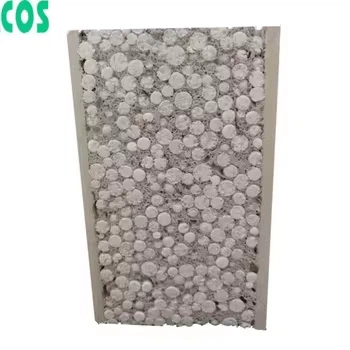
We also have 120mm EPS Cement Sandwich Panel, which combines the strength of cement with the insulation and seismic - resistance properties of EPS. These panels are suitable for both residential and commercial buildings in earthquake - prone areas.
Conclusion
In conclusion, EPS sandwich panels have good seismic performance. Their lightweight nature, energy - dissipation mechanisms, flexibility, and ductility make them a suitable choice for construction in earthquake - prone regions. However, proper seismic design and engineering are necessary to ensure optimal performance.
If you are considering using EPS sandwich panels for your construction project, especially in an area with seismic activity, we are here to assist you. Our team of experts can provide you with detailed information about our products and help you design a structure that meets your specific seismic requirements. Contact us to start a discussion about your project and explore how our EPS sandwich panels can be the ideal solution for your construction needs.
References
- "Seismic Performance of Lightweight Building Materials" - Journal of Structural Engineering
- "Energy Dissipation in Composite Structures" - International Journal of Earthquake Engineering
- "Case Studies of Buildings with EPS Sandwich Panels in Earthquake - Affected Areas" - Construction Research Institute Reports