
Soundproof EPS (Expanded Polystyrene) sandwich panels have gained significant popularity in the construction industry due to their excellent insulation properties and cost - effectiveness. As a supplier of Soundproof EPS Sandwich Panels, I am often asked about the Sound Transmission Class (STC) of these panels. In this blog, I will delve into what STC is, how it relates to Soundproof EPS Sandwich Panels, and the factors that influence the STC rating of these panels.
Understanding Sound Transmission Class (STC)
The Sound Transmission Class is a single - number rating that describes how well a building partition attenuates airborne sound. It is a standardized measure used in the United States and many other countries to quantify the sound - insulating performance of partitions such as walls, floors, and ceilings. The STC rating is determined by testing a partition in a laboratory environment according to ASTM E90 (Standard Test Method for Laboratory Measurement of Airborne Sound Transmission Loss of Building Partitions and Elements).
The test involves generating a range of frequencies of sound on one side of the partition and measuring the sound level reduction on the other side. The measured sound transmission loss values at different frequencies are then compared to a reference contour. The STC rating is the highest integer value for which the reference contour does not exceed the measured sound transmission loss values at 16 critical frequencies between 125 Hz and 4000 Hz.
A higher STC rating indicates better sound - insulating performance. For example, a partition with an STC rating of 50 will block more sound than a partition with an STC rating of 30. In general, an STC rating of 40 - 50 is considered good for normal residential applications, while an STC rating of 50 - 60 or higher is required for more demanding environments such as recording studios or hospitals.
Soundproof EPS Sandwich Panels and STC
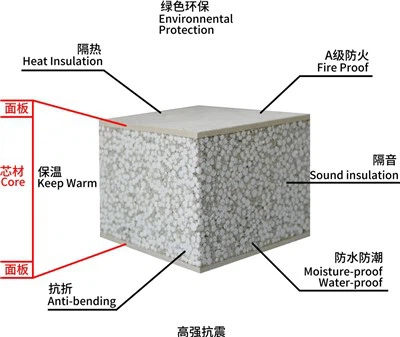
Soundproof EPS Sandwich Panels are composite panels consisting of an EPS core sandwiched between two outer layers, which can be made of materials such as metal, cement, or gypsum. The EPS core provides excellent thermal insulation, while the outer layers contribute to the structural strength and sound - insulating properties of the panel.
The STC rating of Soundproof EPS Sandwich Panels depends on several factors, including the thickness of the panel, the density of the EPS core, and the type of outer layers. Thicker panels generally have higher STC ratings because they provide more mass and distance for the sound waves to travel through, which increases the sound absorption and reflection. For example, a 120mm EPS Cement Sandwich Panel will typically have a higher STC rating than a thinner panel.
The density of the EPS core also plays a crucial role in the sound - insulating performance of the panel. Higher - density EPS cores can absorb more sound energy, resulting in better sound insulation. However, increasing the density of the EPS core also increases the cost of the panel, so a balance needs to be struck between performance and cost.
The type of outer layers can significantly affect the STC rating of the panel. Metal outer layers are often used for their strength and durability, but they can also reflect sound waves. Cement and gypsum outer layers, on the other hand, can absorb sound energy and provide better sound insulation. For instance, an EPS Partition Wall Panel with cement outer layers may have a different STC rating compared to a panel with metal outer layers.


Factors Influencing the STC Rating of Soundproof EPS Sandwich Panels
Panel Thickness
As mentioned earlier, panel thickness is a key factor in determining the STC rating. A thicker panel provides more material for the sound waves to interact with, increasing the chances of sound absorption and reflection. For example, an 180mm Sandwich Panel Wall will generally have a higher STC rating than a 100mm panel. The additional thickness allows for more layers of material to disrupt the sound waves, reducing their intensity as they pass through the panel.
Core Density
The density of the EPS core affects its ability to absorb sound. Higher - density EPS cores have more material per unit volume, which means there are more opportunities for the sound waves to be absorbed. However, increasing the core density also increases the weight of the panel and its cost. Therefore, it is important to select the appropriate core density based on the specific sound - insulating requirements and budget of the project.
Outer Layer Material
The choice of outer layer material can have a significant impact on the STC rating. Different materials have different acoustic properties. For example, metal is a hard and reflective material, which can cause sound waves to bounce off the panel rather than being absorbed. In contrast, cement and gypsum are more porous and can absorb sound energy. The surface finish of the outer layer also matters. A rough surface can scatter sound waves, reducing their intensity.
Installation Quality
Even if a Soundproof EPS Sandwich Panel has a high STC rating on paper, poor installation can significantly reduce its actual sound - insulating performance. Gaps or cracks in the panel joints can allow sound to leak through, bypassing the sound - insulating properties of the panel. Proper sealing and installation techniques are essential to ensure that the panel performs as expected.
Applications of Soundproof EPS Sandwich Panels Based on STC Rating
Residential Buildings
In residential buildings, Soundproof EPS Sandwich Panels with an STC rating of 40 - 50 are commonly used for interior partitions. These panels can effectively reduce the transmission of normal household noises such as conversations, television sounds, and footsteps. For example, using EPS Partition Wall Panel in a multi - room apartment can create a more peaceful living environment by separating different living areas.
Commercial Buildings
In commercial buildings such as offices, hotels, and restaurants, higher STC ratings are often required. Panels with an STC rating of 50 - 60 can be used to create private meeting rooms, hotel rooms, or dining areas where noise control is important. For example, in a hotel, using Soundproof EPS Sandwich Panels with a high STC rating can ensure that guests have a quiet and comfortable stay.
Industrial Buildings
In industrial settings, where there are high - level noises from machinery and equipment, Soundproof EPS Sandwich Panels with even higher STC ratings may be needed. These panels can be used to create sound - insulated enclosures around noisy machinery, reducing the noise pollution in the workplace and protecting the hearing of workers.
Conclusion
The Sound Transmission Class (STC) is an important metric for evaluating the sound - insulating performance of Soundproof EPS Sandwich Panels. As a supplier, I understand the importance of providing panels with the appropriate STC rating for different applications. The STC rating of these panels is influenced by factors such as panel thickness, core density, outer layer material, and installation quality.
If you are in the market for Soundproof EPS Sandwich Panels and need to consider the STC rating for your project, I encourage you to contact me for more information. I can help you select the right panels based on your specific sound - insulating requirements, budget, and application. Whether you are building a residential home, a commercial building, or an industrial facility, I have the expertise and products to meet your needs. Let's start a conversation about how my Soundproof EPS Sandwich Panels can enhance the acoustic performance of your project.
References
- ASTM E90 - Standard Test Method for Laboratory Measurement of Airborne Sound Transmission Loss of Building Partitions and Elements.
- Acoustical Society of America publications on building acoustics.
- Industry reports on the use of Soundproof EPS Sandwich Panels in construction.