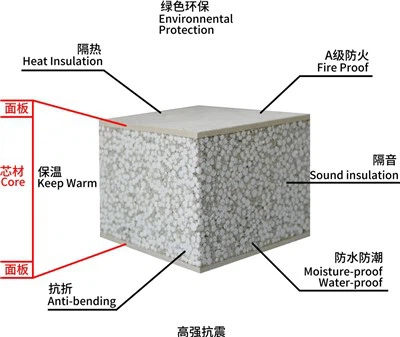

As a supplier of 150mm EPS insulation boards, I often get asked about the heat capacity of these boards. Heat capacity is a crucial property when it comes to insulation materials, as it directly impacts their ability to regulate temperature and save energy. In this blog post, I'll delve into what heat capacity is, how it relates to 150mm EPS insulation boards, and why it matters for your projects.
Understanding Heat Capacity
Before we discuss the heat capacity of 150mm EPS insulation boards, let's first understand what heat capacity means. Heat capacity, denoted as (C), is the amount of heat energy required to raise the temperature of a given substance by a certain amount. Mathematically, it is expressed as (C = \frac{Q}{\Delta T}), where (Q) is the heat energy added or removed, and (\Delta T) is the change in temperature.
The SI unit of heat capacity is joules per kelvin (J/K). However, in the context of building materials, it is often more practical to consider specific heat capacity ((c)), which is the heat capacity per unit mass. The formula for specific heat capacity is (c=\frac{C}{m}), where (m) is the mass of the substance. The SI unit of specific heat capacity is joules per kilogram - kelvin (J/(kg·K)).
Heat Capacity of EPS Insulation Boards
Expanded Polystyrene (EPS) is a lightweight, rigid, and closed - cell foam plastic. The specific heat capacity of EPS typically ranges from about 1.3 to 1.4 kJ/(kg·K). This value can vary slightly depending on factors such as the density of the EPS, the manufacturing process, and any additives used.
For a 150mm EPS insulation board, the heat capacity is influenced by its volume, density, and the specific heat capacity of EPS. The density of EPS insulation boards can vary, but a common range for general - purpose 150mm EPS boards is between 15 and 30 kg/m³.
Let's calculate the heat capacity of a 150mm EPS insulation board with a density of 20 kg/m³. First, we need to find the mass of the board. Assume the board has an area of 1 m². The volume (V) of the 150mm (or 0.15 m) thick board is (V=A\times h = 1m^{2}\times0.15m = 0.15m^{3}).
Using the density formula (\rho=\frac{m}{V}), where (\rho = 20kg/m^{3}), we can find the mass (m=\rho\times V=20kg/m^{3}\times0.15m^{3}=3kg).
Given a specific heat capacity (c = 1.35kJ/(kg·K)) (a mid - range value for EPS), the heat capacity (C) of the board is (C = m\times c=3kg\times1.35kJ/(kg·K)=4.05kJ/K).


Why Heat Capacity Matters for 150mm EPS Insulation Boards
Energy Efficiency
The heat capacity of 150mm EPS insulation boards plays a vital role in energy - efficient building design. A higher heat capacity means the board can store more heat energy. In a building, this can help to moderate temperature fluctuations. During the day, when the outside temperature is high, the EPS board absorbs heat, reducing the amount of heat that enters the building. At night, when the outside temperature drops, the board releases the stored heat, keeping the interior warmer. This reduces the need for heating and cooling systems, leading to lower energy consumption and cost savings.
Thermal Comfort
In addition to energy efficiency, heat capacity also contributes to thermal comfort. By reducing temperature swings, the EPS insulation board creates a more stable indoor environment. Occupants are less likely to experience sudden changes in temperature, which can be uncomfortable. This is especially important in regions with extreme climates, where temperature variations can be significant.
Fire Safety
EPS insulation boards have relatively low heat capacity compared to some other materials. This means that in the event of a fire, they do not store large amounts of heat. As a result, they are less likely to contribute to the spread of fire by releasing stored heat energy. However, it's important to note that EPS is a combustible material, and proper fire - safety measures should always be taken when using it in construction.
Our 150mm EPS Insulation Boards
As a supplier of 150mm EPS insulation boards, we offer high - quality products with consistent heat capacity and other insulation properties. Our boards are manufactured using advanced technology to ensure uniform density and structure, which in turn guarantees reliable performance.
We also provide a range of related products, such as EPS Insulation Panels, EPS Partition Wall Panel, and 120mm EPS Wall Panels. These products are designed to meet different insulation needs in various construction projects, from residential buildings to commercial complexes.
Contact Us for Procurement
If you are interested in our 150mm EPS insulation boards or any of our other products, we encourage you to contact us for procurement. Our team of experts is ready to assist you with product selection, technical advice, and any other questions you may have. Whether you are an architect, builder, or contractor, we can provide the insulation solutions you need to make your project a success.
References
- ASHRAE Handbook - Fundamentals. American Society of Heating, Refrigerating and Air - Conditioning Engineers.
- "Thermal Properties of Building Materials." Building Research Establishment.
- "Expanded Polystyrene (EPS) Insulation: A Technical Guide." EPS Industry Alliance.