
What is the flexural strength of 120mm EPS wall panels?
As a supplier of 120mm EPS (Expanded Polystyrene) wall panels, I often encounter inquiries about the flexural strength of these panels. Flexural strength is a crucial property that determines the panel's ability to withstand bending forces without breaking. In this blog post, I will delve into the concept of flexural strength, explain how it is measured, and discuss the factors that influence the flexural strength of 120mm EPS wall panels.
Understanding Flexural Strength
Flexural strength, also known as bending strength, is the maximum stress that a material can withstand when subjected to a bending load before it fails. In the case of 120mm EPS wall panels, flexural strength is an important consideration because these panels are often used in applications where they may be subjected to bending forces, such as in partition walls or exterior cladding.
When a 120mm EPS wall panel is subjected to a bending load, it experiences both tension and compression forces. The outer surface of the panel on the convex side is in tension, while the inner surface on the concave side is in compression. The flexural strength of the panel is determined by its ability to resist these forces without cracking or breaking.
Measuring Flexural Strength
The flexural strength of 120mm EPS wall panels is typically measured using a three - point bending test. In this test, a panel specimen is placed on two supports and a load is applied at the center of the specimen. The load is gradually increased until the specimen fails, and the maximum load at failure is recorded.
The flexural strength (σ) can be calculated using the following formula:
σ = (3FL) / (2bd²)
Where:
- F is the maximum load at failure (N)
- L is the span length between the supports (mm)
- b is the width of the specimen (mm)
- d is the thickness of the specimen (mm)
The test is usually conducted in accordance with relevant standards, such as ASTM C468 for EPS insulation products. These standards specify the test conditions, including the specimen size, support span, and loading rate, to ensure consistent and comparable results.
Factors Influencing Flexural Strength
Several factors can influence the flexural strength of 120mm EPS wall panels. These include:
Density of EPS
The density of the EPS material used in the panel is one of the most significant factors affecting flexural strength. Generally, higher - density EPS panels have higher flexural strength. This is because the increased density means there are more polystyrene beads per unit volume, which provides greater resistance to bending forces. For example, a 120mm EPS wall panel with a density of 20 kg/m³ may have a lower flexural strength compared to a panel with a density of 30 kg/m³.
Skin Material
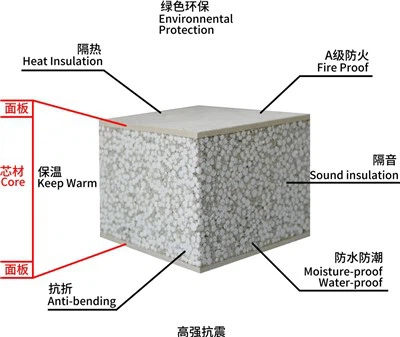
Many 120mm EPS wall panels are faced with a skin material, such as fiber cement or a lightweight foaming material. The type and quality of the skin material can have a significant impact on the flexural strength of the panel. A strong and well - bonded skin can enhance the panel's ability to resist bending forces. For instance, a Fiber Cement Sandwich Panel may have a higher flexural strength than a panel with a weaker or poorly bonded skin.
Panel Thickness
The thickness of the 120mm EPS wall panel also plays a role in its flexural strength. Thicker panels generally have higher flexural strength because they have a greater cross - sectional area to resist bending. However, it's important to note that the relationship between thickness and flexural strength is not always linear, as other factors such as density and skin material also interact.
Manufacturing Process
The manufacturing process of the 120mm EPS wall panels can affect their flexural strength. A well - controlled manufacturing process ensures uniform density distribution and proper bonding between the EPS core and the skin material. Any defects or inconsistencies in the manufacturing process, such as uneven bead expansion or poor adhesion, can reduce the flexural strength of the panels.


Importance of Flexural Strength in Applications
The flexural strength of 120mm EPS wall panels is crucial in various applications. In partition wall applications, the panels need to be able to withstand normal handling and installation forces, as well as any accidental impacts. A panel with sufficient flexural strength will not crack or break during these processes, ensuring a long - lasting and stable partition.
For exterior cladding applications, the panels are exposed to environmental factors such as wind loads. The flexural strength of the panels helps them resist the bending forces exerted by the wind, preventing damage and maintaining the integrity of the building envelope.
In addition, in some cases where the panels are used in load - bearing structures, the flexural strength becomes even more critical. For example, if the panels are used as a part of a mezzanine floor system, they need to support the weight of people and equipment, and a high flexural strength is essential to ensure safety.
Our 120mm EPS Wall Panels
As a supplier of 120mm EPS wall panels, we are committed to providing high - quality products with excellent flexural strength. Our panels are manufactured using advanced technology and strict quality control measures to ensure uniform density and proper bonding.
We offer a range of Lightweight Foaming Partition Panel and Soundproof EPS Sandwich Panel options, each designed to meet different customer requirements. Our panels are available in various densities and skin materials, allowing customers to choose the most suitable product for their specific applications.
Contact Us for Purchase and Negotiation
If you are interested in our 120mm EPS wall panels and want to learn more about their flexural strength or other properties, we welcome you to contact us. Our team of experts is ready to provide you with detailed information, answer your questions, and assist you in selecting the right product for your project. Whether you are a contractor, builder, or architect, we can work with you to meet your needs and ensure the success of your project.
References
- ASTM C468 - Standard Specification for Rigid, Cellular Polystyrene Thermal Insulation
- Technical literature on EPS insulation products from leading manufacturers.