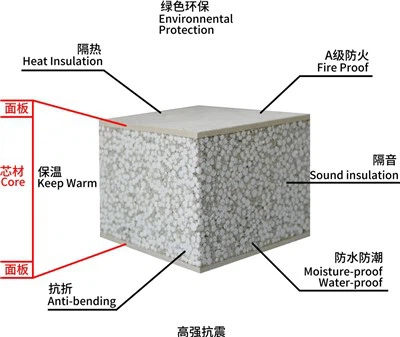

As a supplier of exterior wall sandwich panels, I often encounter inquiries about the bending resistance of these panels. Bending resistance is a crucial property that determines the structural integrity and performance of exterior wall sandwich panels in various applications. In this blog post, I will delve into the concept of bending resistance, its significance, and the factors that influence it.
Understanding Bending Resistance
Bending resistance refers to the ability of a material or structure to withstand bending forces without undergoing excessive deformation or failure. In the context of exterior wall sandwich panels, bending resistance is particularly important as these panels are often subjected to various loads, including wind pressure, snow load, and self - weight. When a panel is exposed to a bending force, it experiences tension on one side and compression on the other. The panel's ability to resist these internal stresses determines its overall bending performance.
Significance of Bending Resistance in Exterior Wall Sandwich Panels
- Structural Integrity: A high bending resistance ensures that the exterior wall sandwich panel can maintain its shape and structural integrity under normal and extreme loading conditions. This is essential for the long - term stability of the building envelope and the safety of the occupants.
- Weather Resistance: Good bending resistance helps the panel to better withstand the forces exerted by wind and snow. In regions with high wind speeds or heavy snowfall, panels with low bending resistance may deform or even break, leading to water infiltration and damage to the building's interior.
- Aesthetic Appeal: Panels with sufficient bending resistance are less likely to develop visible cracks or deformations over time. This helps to maintain the aesthetic appearance of the building facade, which is important for both commercial and residential properties.
Factors Affecting the Bending Resistance of Exterior Wall Sandwich Panels
- Core Material: The core material of the sandwich panel plays a significant role in determining its bending resistance. For example, panels with a Foam Concrete Cement Sandwich Panel core offer different bending characteristics compared to those with a polystyrene or polyurethane core. Foam concrete cement cores can provide relatively high compressive strength and stiffness, which contribute to better bending resistance.
- Face Sheets: The type, thickness, and material of the face sheets also impact the panel's bending performance. Metal face sheets, such as steel or aluminum, are commonly used due to their high strength - to - weight ratio. Thicker face sheets generally result in higher bending resistance, but they also increase the panel's weight.
- Panel Thickness: Generally, thicker panels have better bending resistance. As the thickness of the panel increases, its moment of inertia also increases, which allows it to resist bending forces more effectively. For instance, a 120mm EPS Cement Sandwich Panel is likely to have better bending performance than a thinner panel.
- Bonding between Layers: A strong bond between the core material and the face sheets is crucial for the panel's bending resistance. If the bond is weak, the layers may delaminate under bending forces, leading to a significant reduction in the panel's structural performance.
Testing the Bending Resistance of Exterior Wall Sandwich Panels
To ensure the quality and performance of exterior wall sandwich panels, it is necessary to conduct bending tests. These tests are typically carried out in accordance with relevant standards, such as ASTM or ISO standards. In a bending test, a panel is supported at two points and a load is applied at the center. The load is gradually increased until the panel reaches its maximum bending capacity or shows signs of failure.
The results of the bending test are usually expressed in terms of the maximum load the panel can withstand, the deflection at a given load, or the modulus of rupture. These values provide valuable information for designers, contractors, and building owners to assess the suitability of the panel for a particular application.
Our Product Range and Bending Resistance
At our company, we offer a wide range of exterior wall sandwich panels, including Lightweight Precast EPS Cement Sandwich Panel. Our panels are designed and manufactured to meet high - quality standards, with a focus on excellent bending resistance.
We use advanced manufacturing processes to ensure a strong bond between the core and the face sheets, and we carefully select the materials to optimize the panel's performance. Our R & D team is constantly working on improving the design and materials of our panels to enhance their bending resistance and other properties.
Conclusion
Bending resistance is a critical property of exterior wall sandwich panels that affects their structural integrity, weather resistance, and aesthetic appeal. By understanding the factors that influence bending resistance and conducting proper testing, we can ensure that our panels meet the requirements of various building projects.
If you are interested in our exterior wall sandwich panels or have any questions about their bending resistance or other properties, please feel free to contact us. We are more than happy to discuss your specific needs and provide you with the best solutions for your building project.


References
- ASTM International. Standard test methods for evaluating the bending properties of construction materials.
- ISO. International standards for testing the mechanical properties of building components.