
Hey there! As a supplier of Waterproof Cement Sandwich Boards, I often get asked a bunch of questions about these boards. One query that pops up quite a bit is, "Is waterproof cement sandwich board suitable for curved surfaces?" Well, let's dig into this topic and find out.
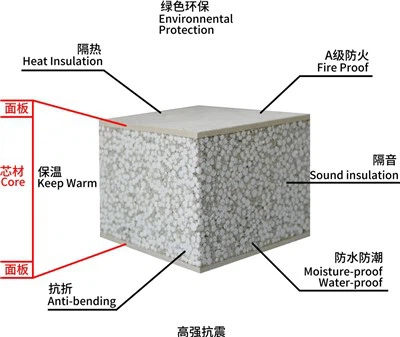
First off, let's talk about what a waterproof cement sandwich board is. It's basically a composite material. You've got a core layer, which is usually made of something like expanded polystyrene (EPS), and it's sandwiched between two layers of cement. This combination gives it some great properties. It's waterproof, which is super important, especially in areas where there's a lot of moisture. It's also got good insulation properties, and it's relatively lightweight, making it easier to handle during installation.
Now, when it comes to curved surfaces, things get a bit tricky. The nature of a waterproof cement sandwich board is that it's typically quite rigid. The cement layers on the outside are hard and don't bend easily. The core, while a bit more flexible, still has its limits. So, in general, using a standard waterproof cement sandwich board on a highly curved surface is not going to be a walk in the park.
One of the main issues is the installation. When you try to fit a rigid board onto a curve, it's likely to crack or break. The cement layers can't stretch or bend to follow the curve, and if you force it, you'll end up with a damaged board. And once the board is damaged, its waterproofing and structural integrity are compromised. That's definitely not what you want.
However, that doesn't mean it's completely impossible to use waterproof cement sandwich boards on curved surfaces. There are some situations where it might work. For example, if the curve is very gentle, like a large - radius arc, you might be able to make it work with a bit of creativity. You can try cutting the board into smaller sections and then fitting them together like puzzle pieces around the curve. This way, each small section can approximate the curve better. But this method requires a lot of skill and patience during installation.
Another option is to look for specially designed waterproof cement sandwich boards that are more flexible. Some manufacturers are now coming up with boards that have a more pliable core or a different formulation of the cement layers to allow for some degree of bending. These boards can be a great solution for curved surfaces, but they might be a bit more expensive than the standard ones.


Let's also consider the application. If it's an exterior application, like a curved exterior wall, you need to think about the long - term durability. Even if you manage to install the board on the curve, it has to withstand the elements. Wind, rain, and temperature changes can put additional stress on the board, especially at the joints if you've cut it into sections. So, you need to make sure that the installation is done properly and that you use high - quality sealants to prevent water from seeping in.
Now, I want to mention some related products that might also be useful for curved surfaces. If you're still looking for a good option for your curved project but the waterproof cement sandwich board isn't quite right, you might want to check out Calcium Silicate Exterior Wall Board. These boards are known for their durability and can sometimes be more adaptable to different shapes. Another option is the Exterior Wall Sandwich Panel, which comes in various configurations and might have a better chance of working on a curve. And if you're focused on insulation, Expanded Polystyrene Wall Panels could be worth considering.
In conclusion, while standard waterproof cement sandwich boards aren't the most straightforward choice for curved surfaces, it's not an absolute no - go. With the right approach, such as using smaller sections or specially designed boards, you can make it work. But it's important to weigh the pros and cons carefully, considering factors like installation difficulty, cost, and long - term durability.
If you're thinking about a project involving curved surfaces and you're interested in our waterproof cement sandwich boards or any of our other products, I'd love to have a chat with you. Whether you need more information, a quote, or just some advice on the best product for your project, don't hesitate to reach out. We're here to help you make the right choice for your construction needs.
References
- Construction Materials Handbook: A guide to various building materials and their properties.
- Industry research on the adaptability of composite boards to different surfaces.