
Earthquakes are one of the most destructive natural disasters, posing a significant threat to buildings and human lives. In earthquake - prone areas, the seismic performance of building materials is of utmost importance. As a supplier of EPS Partition Wall Panels, I am often asked about how these panels perform in terms of earthquake resistance. In this blog, I will delve into the characteristics of EPS Partition Wall Panels and their performance during seismic events.


Understanding EPS Partition Wall Panels
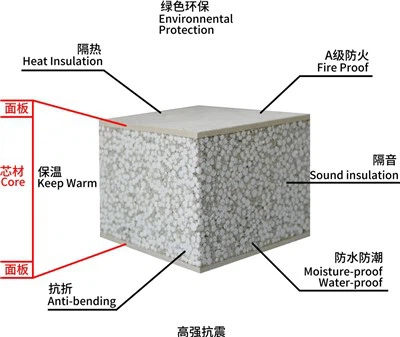
EPS, or Expanded Polystyrene, is a lightweight and rigid foam plastic material. EPS Partition Wall Panels are composed of an EPS core sandwiched between two layers of facing materials, such as Calcium Silicate Board for Prefabricated Houses. These panels are widely used in both residential and commercial buildings due to their various advantages, including excellent insulation, soundproofing, and ease of installation.
Key Factors Affecting Earthquake Resistance
Lightweight Nature
One of the most significant advantages of EPS Partition Wall Panels in earthquake resistance is their lightweight. Compared to traditional brick or concrete walls, EPS panels are much lighter. The weight of a building has a direct impact on the seismic forces it experiences. According to Newton's second law of motion (F = ma), where F is the force, m is the mass, and a is the acceleration. In an earthquake, the acceleration is determined by the seismic activity, and a lighter building (with lower mass) will experience smaller seismic forces.
For example, in a seismic event, a building with heavy walls will have a larger inertial force acting on it, which can lead to more significant structural damage. In contrast, EPS Partition Wall Panels reduce the overall weight of the building, thereby decreasing the seismic forces transmitted to the structure. This reduction in seismic forces can prevent excessive stress on the building's foundation and structural framework, reducing the risk of collapse.
Flexibility and Energy Absorption
EPS material has a certain degree of flexibility. During an earthquake, the ground shakes, and buildings are subjected to dynamic forces. The flexibility of EPS Partition Wall Panels allows them to deform to some extent without breaking. This deformation helps in absorbing and dissipating the seismic energy.
When an earthquake occurs, the seismic waves transfer energy to the building. Instead of rigidly resisting this energy, which can lead to brittle failure, the EPS panels can bend and flex. This ability to deform acts as a shock - absorber, reducing the impact of the seismic waves on the building's structure. The energy absorbed by the panels is dissipated in the form of internal friction within the EPS material and the interface between the EPS core and the facing layers.
Good Connection Systems
Proper connection systems are crucial for the earthquake resistance of EPS Partition Wall Panels. A well - designed connection system ensures that the panels are securely attached to the building's structure. For instance, the panels can be connected to the floor, ceiling, and adjacent walls using specialized connectors or adhesives.
These connection systems not only hold the panels in place but also allow for some relative movement between the panels and the structure during an earthquake. This relative movement helps in accommodating the seismic forces and prevents the panels from detaching or causing damage to the surrounding structure. Moreover, a good connection system distributes the seismic forces evenly across the building, ensuring that no single part of the structure is over - stressed.
Case Studies and Research Findings
Numerous studies and real - world case studies have demonstrated the excellent earthquake - resistant performance of EPS Partition Wall Panels. In some earthquake - prone regions, buildings constructed with EPS panels have shown remarkable resilience during seismic events.
For example, in a small - scale earthquake in a certain area, a building with EPS Partition Wall Panels only suffered minor damage to the panels' surface, while the overall structure remained intact. In contrast, nearby buildings with traditional walls had significant cracks and structural damage.
Research institutions have also conducted seismic tests on EPS panels. These tests simulate earthquake conditions in a controlled environment. The results consistently show that EPS Partition Wall Panels can withstand a certain level of seismic activity without catastrophic failure. The panels' ability to absorb energy and their lightweight nature contribute to their good performance in these tests.
Comparison with Other Partition Materials
When compared with other partition materials, EPS Partition Wall Panels have distinct advantages in terms of earthquake resistance.
Brick and Concrete Partitions: Brick and concrete partitions are heavy and rigid. In an earthquake, they are more likely to crack and collapse due to the large seismic forces they experience. Their lack of flexibility means that they cannot absorb and dissipate seismic energy effectively, leading to more severe damage to the building.
Gypsum Board Partitions: While gypsum board partitions are also lightweight, they are relatively brittle. In an earthquake, they can easily break into pieces, especially at the joints. EPS Partition Wall Panels, on the other hand, are more durable and can withstand more significant deformation without complete failure.
Other Advantages in Earthquake - Prone Areas
In addition to their earthquake - resistant properties, EPS Partition Wall Panels offer other advantages in earthquake - prone areas.
Rapid Reconstruction: After an earthquake, the ability to quickly reconstruct damaged buildings is crucial. EPS Partition Wall Panels are easy to install. They can be pre - fabricated in a factory and then transported to the construction site for rapid assembly. This reduces the time required for reconstruction, allowing people to return to their normal lives more quickly.
Insulation and Comfort: Earthquakes can disrupt the normal living conditions of people. EPS Partition Wall Panels have excellent insulation properties, which can help maintain a comfortable indoor temperature even in the aftermath of an earthquake. This is especially important in regions where earthquakes may occur in extreme weather conditions.
Conclusion
In conclusion, EPS Partition Wall Panels perform very well in terms of earthquake resistance. Their lightweight nature, flexibility, energy - absorption capacity, and good connection systems make them a suitable choice for buildings in earthquake - prone areas. By reducing the seismic forces on the building, absorbing and dissipating seismic energy, and withstanding deformation, these panels can significantly improve the safety and resilience of buildings during seismic events.
If you are considering building or renovating a property in an earthquake - prone area, Lightweight Foaming Partition Panel and EPS Cement Sandwich Insolation Board are excellent options. Our company offers high - quality EPS Partition Wall Panels that are designed to meet the highest standards of earthquake resistance. If you are interested in purchasing our products or have any questions about their performance, please feel free to contact us for further discussion and procurement negotiation.
References
- Building Seismic Safety Council. (Year). Seismic Design Manual for Buildings.
- International Building Code. (Year). Provisions for Seismic Design.
- Research reports on the seismic performance of EPS materials from relevant academic institutions.