
Hey there! As a supplier of Waterproof EPS Sandwich Panels, I often get asked if these panels have good flexibility. Well, let's dive right into it and find out.
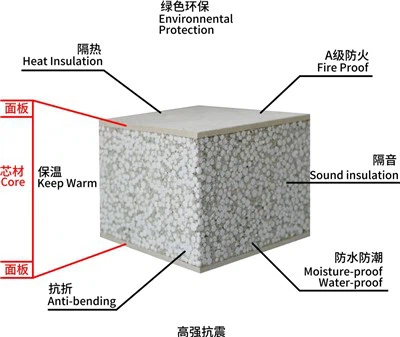
First off, let's understand what Waterproof EPS Sandwich Panels are. EPS stands for Expanded Polystyrene, which is a lightweight and insulating material. These sandwich panels consist of an EPS core sandwiched between two outer layers. The outer layers can be made of various materials like metal, cement, or other composites, and they are designed to be waterproof. This combination gives the panels excellent insulation properties and protection against moisture.
Now, when it comes to flexibility, it's a bit of a mixed bag. Flexibility can be defined in different ways. In terms of physical bending, Waterproof EPS Sandwich Panels do have some limitations. The EPS core is relatively rigid, and the outer layers, especially if they are made of metal or a hard composite, don't allow for a high degree of bending. For example, you can't just take a panel and bend it into a tight curve like you would with a piece of rubber.
However, in practical applications, the panels do show a certain level of flexibility. Let's say you're using these panels for a pre - fabricated building. During the installation process, there might be some minor adjustments needed to fit the panels precisely into the structure. The panels can tolerate a small amount of pressure and movement without cracking or breaking. This is important because in real - world construction, it's rare to have a perfectly straight and uniform frame.
Another aspect of flexibility is in terms of design and application. Waterproof EPS Sandwich Panels are highly versatile. You can use them for a wide range of projects, from small storage sheds to large industrial buildings. They come in different sizes and thicknesses, which allows you to choose the right panel for your specific needs. For instance, if you're building a cold storage facility, you might opt for thicker panels for better insulation. On the other hand, for a simple partition wall in an office, thinner panels would do the job.
Let's talk about some of the specific types of Waterproof EPS Sandwich Panels and how their flexibility varies.
100mm Prefabricated Insulated Wall Panels
These 100mm Prefabricated Insulated Wall Panels are quite popular for building walls. The 100mm thickness gives them good insulation properties, but it also means they are a bit more rigid compared to thinner panels. However, they can still be adjusted slightly during installation. The outer layers are usually strong enough to withstand the normal forces exerted during the building process. For example, when you're aligning the panels with the frame, you can push and pull them a little to get the right fit.
Expanded Polystyrene Wall Panels
Expanded Polystyrene Wall Panels are known for their lightweight nature. They are relatively more flexible compared to some of the other types. The EPS core allows for a bit more give, and the outer layers can be designed to be more forgiving. These panels are great for quick - build projects where you might need to make some on - the - spot adjustments. You can easily cut them to size with basic tools, which adds to their flexibility in terms of installation.


EPS Cement Sandwich Wall Panel
EPS Cement Sandwich Wall Panels have a cement outer layer, which gives them a different kind of flexibility. The cement layer is strong and provides good protection, but it also makes the panel less bendable. However, in terms of durability and resistance to environmental factors, these panels are a great choice. They can handle changes in temperature and humidity without significant damage, which is a form of flexibility in the long - run.
One of the factors that affect the flexibility of Waterproof EPS Sandwich Panels is the quality of the materials used. High - quality EPS cores are more consistent in their density and structure, which can lead to better overall performance. The outer layers also play a crucial role. If they are well - bonded to the core and made of high - grade materials, the panel will be more likely to withstand stress without failure.
Another important consideration is the installation method. Proper installation is key to ensuring that the panels perform as expected. If the panels are not installed correctly, they may be more prone to damage and may not show their full potential in terms of flexibility. For example, if the panels are not properly supported during installation, they could crack under their own weight or due to external forces.
In addition to physical and installation - related flexibility, these panels also offer economic flexibility. They are generally more cost - effective compared to some other building materials. This means that you can get a good - quality building solution without breaking the bank. You can also save on labor costs because they are relatively easy to install, especially when compared to traditional brick - and - mortar construction.
So, to sum it up, while Waterproof EPS Sandwich Panels may not have the same kind of flexibility as a soft, bendable material, they do offer a good level of flexibility in practical applications. They can tolerate minor adjustments during installation, are versatile in terms of design and application, and provide economic benefits.
If you're considering using Waterproof EPS Sandwich Panels for your next project, I'd be more than happy to discuss your specific needs. Whether you're looking for 100mm Prefabricated Insulated Wall Panels, Expanded Polystyrene Wall Panels, or EPS Cement Sandwich Wall Panel, we have a wide range of options to choose from. Reach out to us, and let's start a conversation about how these panels can work for you.
References
- "Building Materials Handbook" - A comprehensive guide on different building materials and their properties.
- Industry reports on the performance of EPS sandwich panels in various construction projects.