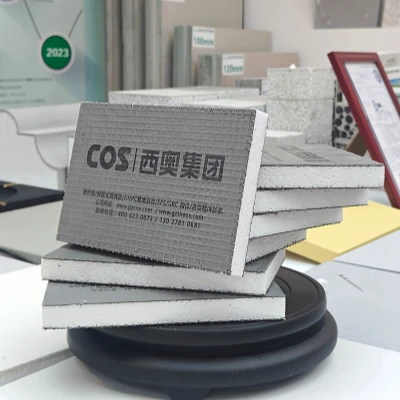
The technical standards of EPS sandwich panels mainly include the following aspects:
Material requirements: EPS sandwich panels should use expandable polystyrene beads as the main raw material, and form a foam body with a certain density and mechanical properties after heating pre-foaming and curing. The sandwich panel should be made of flame-retardant polystyrene as the core material, and its flame retardant performance should meet the requirements of relevant standards. The outer layer of the sandwich panel should be sealed and protected with high-quality polystyrene or polymer materials to improve its weather resistance and waterproof performance.
Appearance quality: The surface of the sandwich panel should be flat and smooth, without obvious bubbles, cracks, deformation and other defects. The color of the sandwich panel should be uniform and consistent, and there should be no obvious color difference. The dimensional deviation of the sandwich panel should meet the requirements of the relevant standards.
Dimensional deviation: The length deviation of the sandwich panel should not exceed ±2mm, the width deviation should not exceed ±2mm, and the thickness deviation should not exceed ±0.5mm.
Physical properties: The compressive strength of the sandwich panel should not be less than .5kN/m², the compressive strength should not be less than .0kN/m², and the flexural strength should not be less than 4.0kN/m². The thermal conductivity of the sandwich panel shall not be greater than 0.0W/(m·K), and the combustion performance shall meet the requirements of Class B in the "Classification of Combustion Performance of Building Materials and Products". The weather resistance and corrosion resistance of the sandwich panel should meet the requirements of relevant standards.
Combustion performance: The sandwich panel should maintain a certain integrity during the combustion process, and no obvious shrinkage and deformation will occur. The flue gas and toxic gases produced during the combustion process shall meet the requirements of relevant standards.
Weather resistance: After the sandwich panel is exposed to the outdoor environment for a certain period of time, its surface should not appear obvious discoloration, fading, blistering and other phenomena. After the sandwich panel is exposed to the outdoor environment, its mechanical properties and dimensional stability should remain stable.
Corrosion resistance: In the process of long-term use, the sandwich panel should have certain corrosion resistance, such as resistance to ultraviolet rays, rain and snow, acid and alkali and other substances. During the long-term use of the sandwich panel, there should be no obvious corrosion on its surface.
These standards ensure the quality and safety of EPS sandwich panels during production and use, and are suitable for various application scenarios such as thermal insulation and fire protection.